We sat down with Chelsea Cunningham-McLean, Toi Tangata Kaiārahi (Design, Innovation and Research Lead), to talk about the journey of Te Manunui, the Toi Tangata journal. As lead coordinator and editor, Chelsea has dedicated the past two years to creating a culturally safe process and platform for the open-access kaupapa Māori research journal, Te Manunui.
______________________________________________
Tell us about your background and how your experiences have shaped your path and current mahi.
My research experience and grounding, particularly within Te Koronga, is what shaped how I lead rangahau at Toi Tangata. It is based on the idea that kaupapa Māori isn't theoretical, it's how you work day to day.
I had an opportunity to help lead part of the MAI Journal Te Koronga special issue. That's where my aspiration and confidence to start Te Manunui came from, seeing a kaupapa Māori journal done well, and realising how we could build something similar for Toi Tangata's kaupapa (hauora, tākaro, kori, rangahau, kai). Academia gave me the research rigour, Te Koronga gave me my foundation, belief and confidence, and Toi Tangata provided the support, platform and opportunity.
What was the inspiration behind creating Te Manunui? What was the vision?
It was really all about creating a culturally safe platform for Māori writers to share their passions, kaupapa, and lived experiences of hauora Māori. Providing a space for both experienced kaituhi and first time writers, whether they are community practitioners, early career researchers or tauira. It came from the belief that our stories are ours to tell, in our own words. Too often Māori are the subject of research rather than the narrator; we really wanted to aim to flip that. The bigger question that also drove it was, how do we nurture safe storytelling spaces into real pathways to publication? Te Manunui was our way of trying to answer that.
Why is it important to create spaces and opportunities like Te Manunui? Why was creating a kaupapa Māori journal important to you personally?
Academic and publishing spaces haven't always been designed with Māori in mind. Writing can feel very isolating and our voices can get moulded to fit external expectations. Te Manunui lets whakaaro emerge without compromise, where lived experience counts as knowing. My experience on the MAI Journal Te Koronga special issue showed exactly what was possible and how much of the process (peer review, branding, design, publishing admin and logistics) is invisible until you're inside it. But we still wanted to open that door for others to feel safe in sharing their own stories, rangahau and kaupapa.
Talk us through the process
Starting in early 2025, we held online writing workshops (May–June) building writing capability and whanaungatanga, breaking down the article writing process. Dr Gianna Leoni came in and also spoke on finding your own voice while navigating academic conventions.
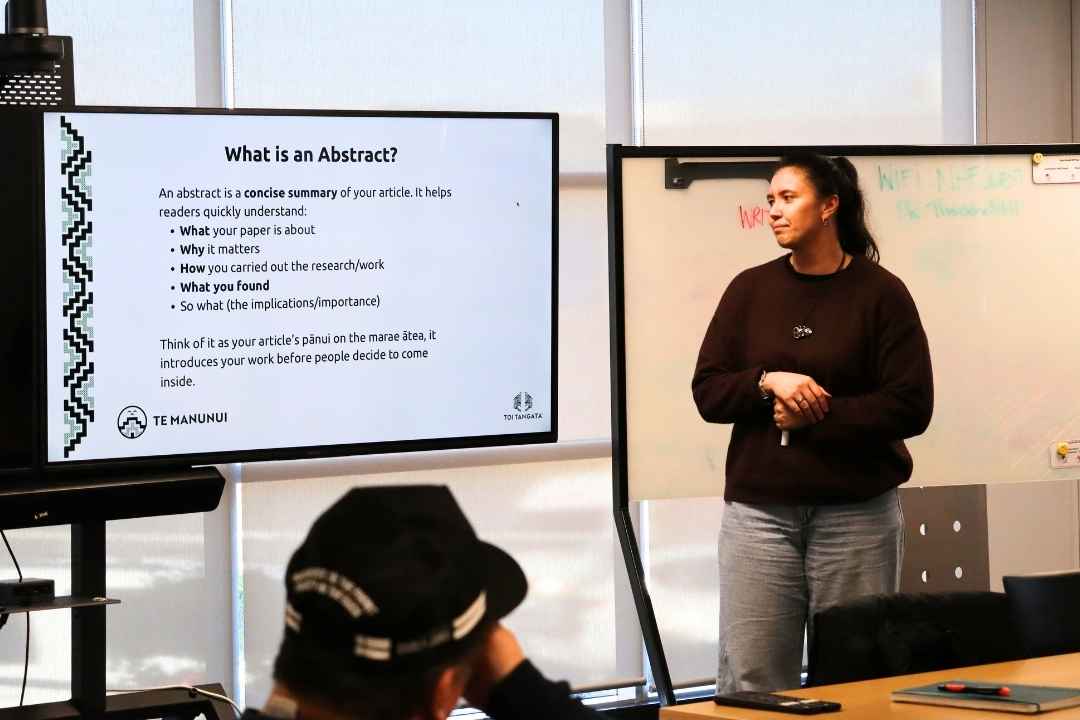
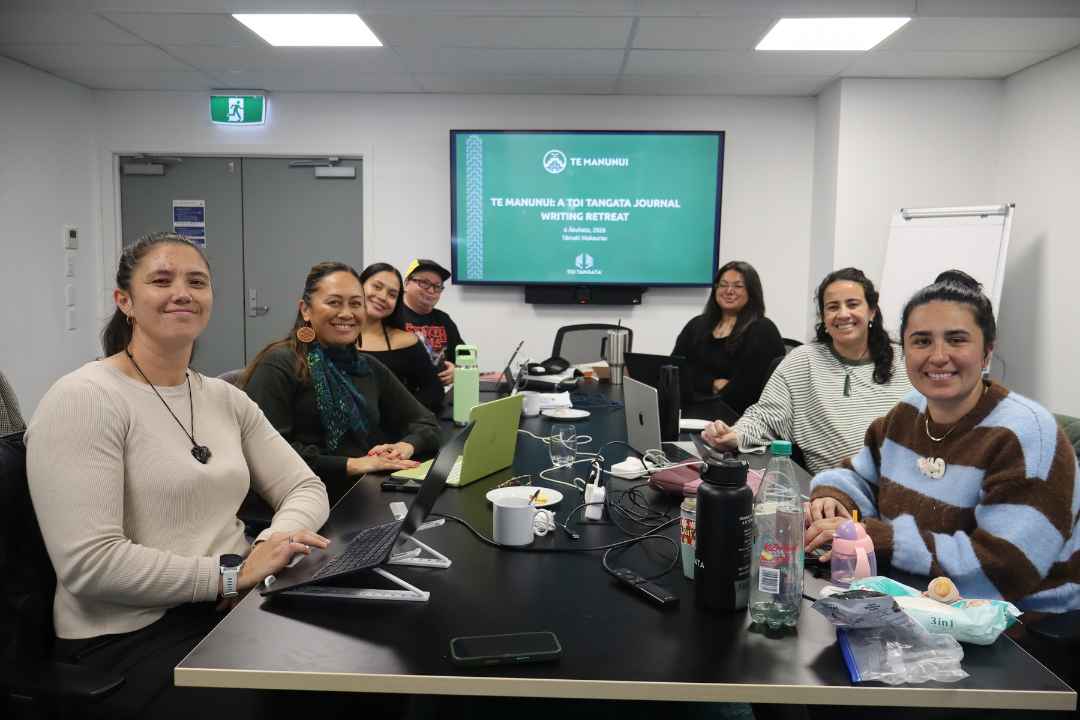
In September 2025 we held a two-day writing retreat in Tāmaki Makaurau at the Toi Tangata office. Day one, we had dedicated writing time, feedback, working through challenges. Day two was an intentional peer review session, facilitated by Dr Ngahuia Mita and Dr Terina Raureti. We also had a practical abstract-writing session that followed, giving every kaituhi a foundation regardless of where their article was at. We started with 12 kaituhi and eight of these articles made it into this first issue, and that is kei te pai, we are not rushing the process for everyone but encouraging them to come back when they are ready to submit. Articles then went through 1-2 peer reviews, kaituhi made their amendments then articles went through a final editing process. Once final read throughs and check were competed but each kaituhi they were handed over to Tahi Designs who designed our final Journal in what we now see it as today.
Who helped make Te Manunui possible?
Te Manunui came together through the generosity of a lot of people. Dr Hauiti Hakopa recommended the karakia, Te Manunui a Ruakapunga, which shaped both the journal's name and its kaupapa, and Professor Anne-Marie Jackson has been a leading mentor throughout, editing and peer reviewing the mahi. Dr Gianna Leoni led one of the writing workshops, speaking to the importance of finding your own voice as a writer, while Dr Ngahuia Mita and Dr Terina Raureti provided tautoko for the writing retreat, guided the peer review process, and wrote the foreword. On the design side, Te Aute McPhee created the tohu, the branding and the meaning woven into it, and Zeus at Tahi Design led the layout and design. Pūtahi Manawa provided funding for the kaupapa. And of course, none of it would exist without the twelve who trusted Te Manunui with their articles, and the peer reviewers who gave their time, feedback and energy.
What have you learned over the past two years/18 months developing this kaupapa?
Definity the process that sits behind a published journal, peer reviews, branding decisions, layout/design, ISSN and publishing logistics. Things you didn't fully see until you were inside it, creating it. Writing shouldn’t be an isolated act, it thrives when there’s whanaungatanga, workshops, and collective support. Overall, it was a huge learning curve, but one I’ve loved, and I know there are plenty more learnings to come!
Tell us about what the name Te Manunui represents.
The name comes from a karakia, Te Manunui a-Ruakapunga, suggested to me after having a kōrero with Dr Hauiti Hakopa.
Manu (in the tohu): represents a figure of authority and movement, one who moves with purpose across different domains of knowledge. That's the kaituhi. Within the manu, the three tapatoru represent Ngā Kete o te Mātauranga, the baskets of knowledge, reinforcing the kaupapa of learning, wisdom, and pursuit of knowledge. Poutama pattern: the journey of the kaituhi, each step symbolising progression toward deeper understanding and insight. Tukutuku: the collective kōrero and whakaaro of the kaituhi, weaving together many kaupapa, ideas, and perspectives. Together it represents a journey of exploration, a weaving of knowledge across realms, and an awakening through the power of our own voices and stories.
What have the writers taught you?
There are a huge range of journeys people bring, Master's students, doctoral candidates, community practitioners, each carrying their own whakapapa into their writing. They have shown me courage, writing about deeply personal, whakapapa-grounded kaupapa isn't easy, and watching them write - in their own ways - has been humbling. They have shown me resilience through the review process, watching people grow as writers in real time and that storytelling restores mana. Several articles, if not all, show healing happening through the act of telling the story, not just the research itself.
What kinds of stories would you love to see in future editions?
The four original kaituhi from this cohort who weren't ready for issue one. I’m hoping to hold space for their mahi when the time is right. I would love to see more breadth across whenua, hauora, tākaro, mātauranga, whakapapa, taiao, and Indigenous resurgence as well as more community champions whose mahi has long gone unrecognised in academic spaces, alongside early career researchers and tauira. And finally, international Indigenous contributors bringing comparative perspectives to the journal.
What do you hope readers take away from the first edition?
That Māori knowledge systems aren't just surviving, they're evolving, adapting, and thriving when given intentional space. For Māori writers to be given recognition and validation, seeing their own experiences reflected without translation or compromise. An invitation, that this journal is proof it's possible, and an encouragement for others to step forward and tell their own stories.
If someone has always wanted to write but doesn't know where to begin, what would you say to them?
Start in community, not isolation. Workshops and shared spaces demystify writing and build confidence. Honour your authentic voice first, then work out how to navigate academic convention, not the other way round. You don't need a finished article to start, an abstract exercise or a single writing session can be enough to find your foundation. Your story is already valid knowledge, you don't need to wait to be an 'expert' to be a narrator of your own experience.
Where do you hope Te Manunui is five years from now?
A bigger team behind the kaupapa as the journal grows. Two issues a year instead of one annual release. International Indigenous contributors, building connections across global Indigenous knowledge systems.
What does success look like?
Success would look like Te Manunui established as a living, ongoing platform, not a one-off, that kaituhi keep returning to. Growth in scale (team, frequency, reach) without losing the culturally safe, supportive process that got issue one made. More writers, including first-timers, feeling confident enough to put their names on their own stories. A track record of turning informal storytelling and lived experience into recognised, published contributions to mātauranga Māori.

