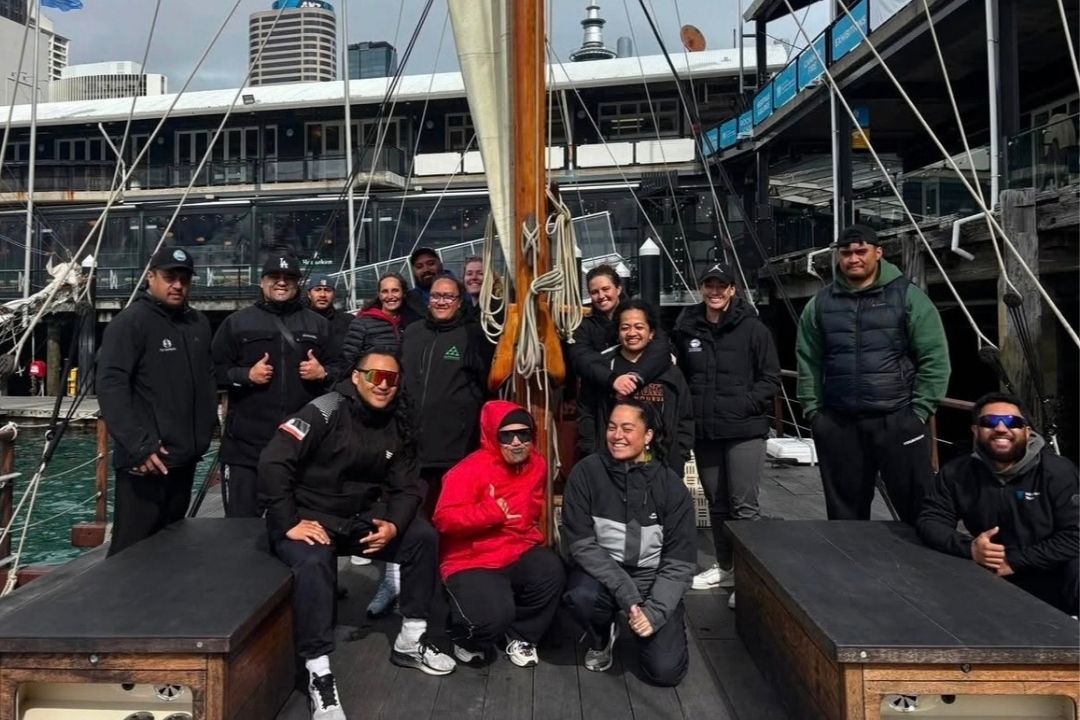
On Friday 28 August, Mātaiao ki Tāmaki took its wānanga to Te Waitematā, sailing on Haunui with Te Toki Voyaging Trust for a day. This term's kaupapa - Tāwhirirangi.
Fourteen kaiako and kaimahi from across Tāmaki and the wider rohe joined the crossing. On board, the crew of Te Toki shared the knowledge systems that traditional waka navigators use to read the environment: wind, swell, the shifting behaviour of the moana, and what it takes to work as one crew once you're out on the water. Rapata Mclean passed on a teaching handed to him by his own kaiako, "When you pray, never ask for good weather, ask for courage."
This was a reminder that as ira tangata, we stand small in the presence of Tangaroa and Hine Moana, and that humility, not control, is the starting point on the water.
The heart of the day was in the winds themselves. The crew of Te Toki walked the rōpū through how they identify different winds at sea, what each one signals, and the cause and effect each has on the moana and on the waka itself. Mātaiao took those working descriptions and set them alongside the traditional Māori names for those same winds: the whakapapa of Tāwhirimātea and Pārāweranui, whose union in this account produced 24 different hau, winds known to te ao Māori.
That pairing is the point of Mātaiao. The kaupapa exists to return mātauranga Māori to its environmental and geographical home, kia hoki te Māori ki ōna akoranga taiao, treating it not as a body of stories to be studied from a distance, but as a living, holistic knowledge system that still reads the taiao accurately today. Naming a wind in te reo Māori on the deck of a waka, moments after the crew of Te Toki had just described its behaviour and its risk, is that principle in practice rather than theory.
Mātaiao ki Tāmaki's next wānanga continues the Tātaiaro framework into its next theme.
Ngā mihi nui ki a Te Toki Voyaging Trust me tō rātou tira mō te rangi whakahirahira.