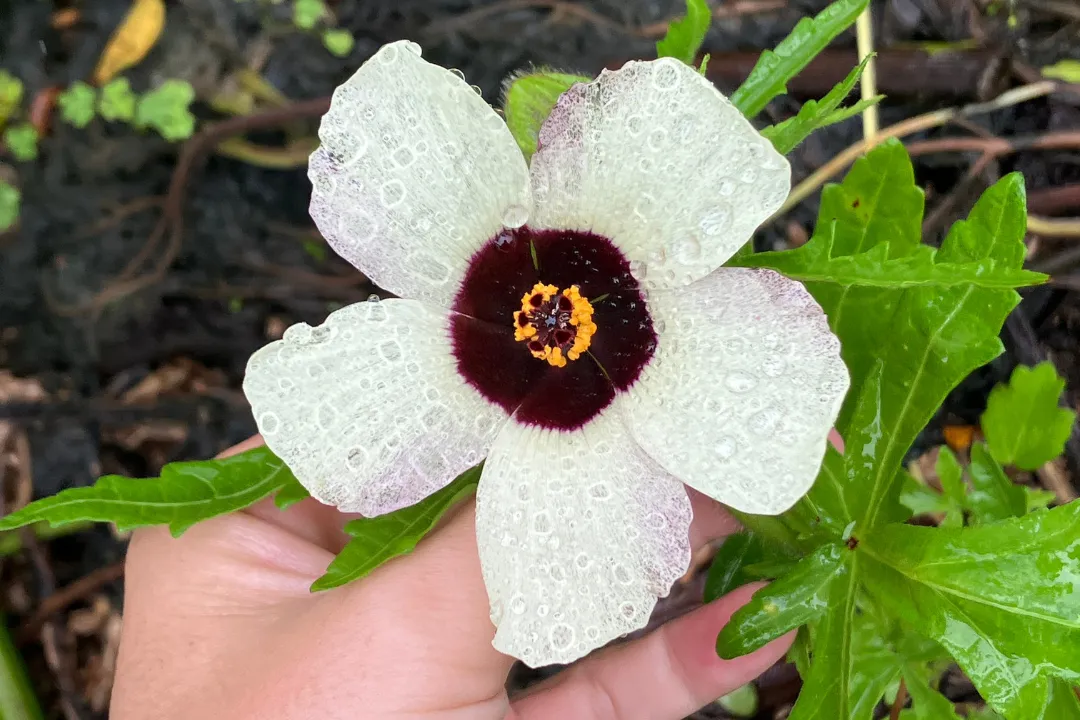
On the two year anniversary of the publishing of 'Intergenerational Intimacies - a whakapapa conceptualisation of kai', our Kaiārahi Haylee interviews co-author Hana, reflecting on how the intergenerational intimacies has continued to shape her life with kai. She reflects on the māra, the commitment that is required when we activate relationships through the growing of kai, and the role of flowers in sustaining our spirits in the mahi.
________________________________
Haylee: We published intergenerational Intimacies in January 2024, I feel like time since the writing of that paper has expanded in a weird way that makes it feel like it's so old. Reflecting on the paper, in your personal life, how has your relationship with kai changed?
Hana: Spending so much time thinking about and articulating the depths of kai within our worlds, our whakapapa, our whānau, really increased my reverence for kai, not only kai that comes from our whenua, our moana, or kai that we grew in our māra, but also kai that we buy from the supermarkets. Each kai is sacred; it has a whakapapa, it has hands that it has passed through, including the kai that arrives to us in plastic, that might be a little (or a lot) processed as well.
Haylee: Can you say a little bit more about reverence.
Hana: I keep coming back to the quote from Jessica Hutchings (2020, p. 23) in the book Te Mahi Māra Hua Parakore where she describes “the ‘miracle’ of fertile soil is … the result of an elaborate choreography of relationships.” I think she really captures the miracle of it all. We are a part of that choreography (or can be!) as tangata, as teina to te taiao. We can learn that elaborate choreography. We can join that dance. There's reverence in being in awe of a single seed or plant, and it's so amazing and important. What also comes up for me here is the mundane, or the everyday. How we show or feel this reverence in everyday moments, not just when we have a big kai for a celebration or haakari, but when we have breakfast before mahi. It's allowed me to pause and appreciate kai in a deepened way.
Haylee: Are there any metaphors that come to mind when you think of the seed, that carry some of what you've learned about the miracle of it all?
Hana: Seeds really beautifully capture the complex and infinite nature of our whakapapa, and the way whakapapa collapses time and space. To think that a seed, sometimes so small, contains so much life, and so many generations. I think that’s true for each of us, and how expansive we are, and can be. This notion of potential, similar to the ways that our sunflowers at the moment are just opening, the yellow petals are poking through, and it looks like it’s about to burst or explode. There's so much energy in that and beauty in that. It happens at so many different scales across our māra, these explosions of life, this outpouring of life.
Haylee: When you decide to establish a relationship with food through the growing of it, it demands certain things of you. What’s something you've learnt from holding the weight, the responsibility of the growing?
Hana: Because so much of my work as a kaupapa Māori researcher is higher level and conceptual, with a lot of engagement with texts and reading (which I love!), growing kai calls for a deep and sustained presence with te taiao, which I have never found or been in tune with so consistently in my life - ever! I think of the way that the māra calls for our presence; to be present with where we are literally. That includes the māra, it also includes the winds, the rain, the maunga to the east, the old trees in the park around the corner, the manu, the bugs. It can conceptually feel like so much to hold, but in the day-to-day it can just look like being present, noticing patterns, or tending to plant. It's so much more than a conceptual activity. You have to actually be outside. That’s been my biggest lesson, it's not in these big intense bursts of mahi, and then you forget about it. It's multiple times a day, it's looking out the window, it's waking up in the morning, it's knowing when the rain is coming, it's pottering around, it's noticing bird song, it's everything that contributes to a sustained engagement with te taiao. This is so important in this moment of hyper-tech-bigger-faster-better world that is imposed on us. Relating to the māra in these deepened and sustained ways has helped me to understand what our broader decolonial or anticolonial movements are calling for, and to think more clearly about what to do amongst it all. I think too there's a lot to learn from Rereata Makiha and his teachings around mahi tirotiro, observation, and understanding ngā tohu o te taiao, and that again, this is not something you can study in a book. You literally have to go outside and look.
Haylee: Would you ask yourself any additional questions? Is there a little corner of yourself that would like to be seen in relation to this kaupapa?
Hana: Such a highlight for me at the moment has been growing flowers in amongst our kai. While Intergenerational Intimacies was all about how we relate to kai, we were living in the Hokianga and gardening with our Aunty Lorraine and our whānau at Kokohuia. This was so influential to our thinking and writing.
In all the aunties’ gardens, and in all the stories I hear about my aunties and nans, including my namesake, Te Hana, they all grew flowers and loved flowers. Flowers were always a part of kai. I really feel like I've tuned into that love or reverence as well, not just in the way that they enhance the visual landscape of the māra, but the whole process is so fun and so beautiful. I get it now. I get all the poetry written about flowers, all the art, through generations. I feel like flowers have really captured me in the last few seasons, and this season is the first time I've been really intentional about the flowers that I want to grow, and how I want them to complement the kai. I am also reminded how as Māori, when we have haakari there's always greenery on the table, there are flowers at the table when we have tangi at our marae, the flowers are always a really important part of that. And we were lucky enough to take on the roles of table setting and flowers at my marae while we were gardening in the Hokianga.
Flowers allowed me to connect with more of my aunties, my grandma, your mama Cindy, and your gran too. It's such a beautiful way to connect with our whānau. Growing flowers, there’s always something to talk about over the phone with them, there’s always so much to catch up on, and there’s also so much to share too. Our loved ones are growing dahlias that we harvested from the same tuber – from Whangārei to Tāmaki, to Rotorua, and Pōneke. And your mum has just given us a cutting of a hydrangea that was your nan’s, who passed away when you were only 5. Um, wow! We now have that growing at our whare. It’s just opened up portals and new realms of connection that I couldn’t have foreseen. How beautiful to have all these relationships taking root in our māra.
Flowers are now such a huge part of my relationship with growing kai, and just gardening in general. They bring me so much joy, and I think that joy is a really important part of being a gardener.
Haylee: Coming back to this idea of the joy of growing flowers, thinking about beyond settler colonialism, or liberation, what is the role of joy, of the flowers in getting you through, or allowing you to hold the weight of the relationships that feel overwhelming sometimes.
Hana: It’s everything! It’s what keeps me present, it’s what keeps me in the māra some days, especially when the seasons are hard, or hot, or dry, or when a pest has gotten to our cucumbers. I will be outside in the garden every single day because there might be a flower that only blooms for a day, or there might be a dahlia that has popped up that I've been waiting for, and so I think that really is what keeps it sustainable and fills me up. I think here of the sustainability of our movements, and our hauora, especially if this is intergenerational work, if this is our life’s work, dreaming and building beyond settler colonialism. I really hope that all of us have our flowers (metaphorically, or literally!) as we fight for a better world, whatever that might be. The things that bring us joy, get us up, tune us into that elaborate choreography, and help us to realise the beauty that surrounds us.

