For the past eight weeks, I have been facilitating the online learning wānanga Exploring the Foundations of Kai Māori Kai Ora cohort two, alongside 13 tauira from across Aotearoa — from public health practitioners to grassroots kai organisation members to marae representatives.
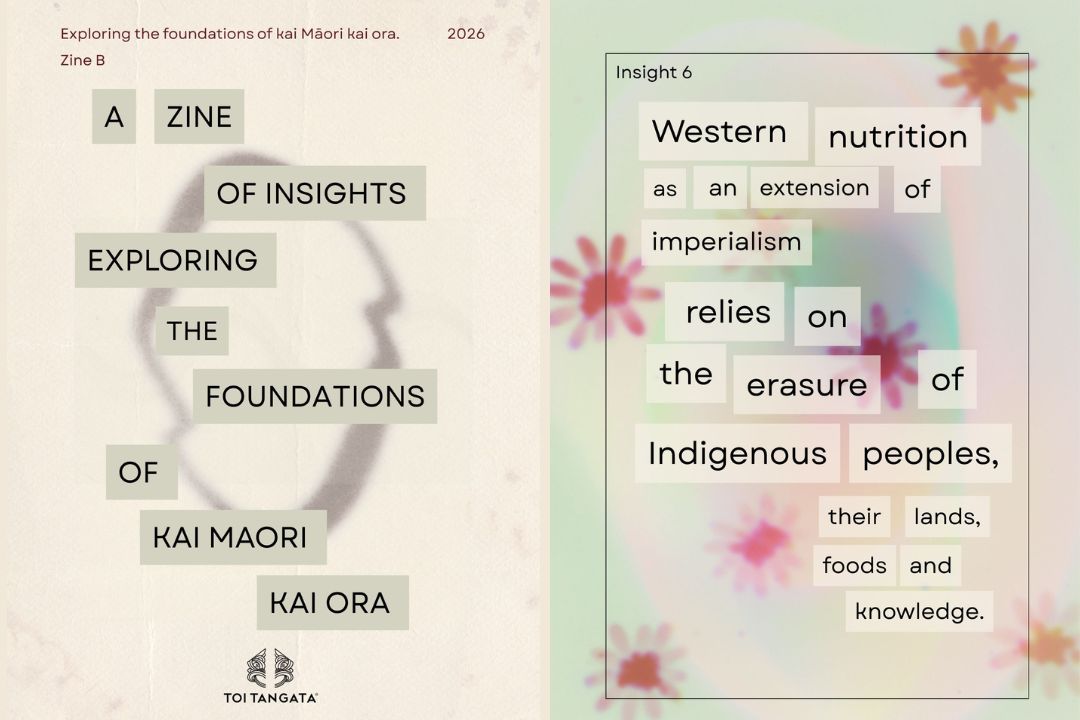
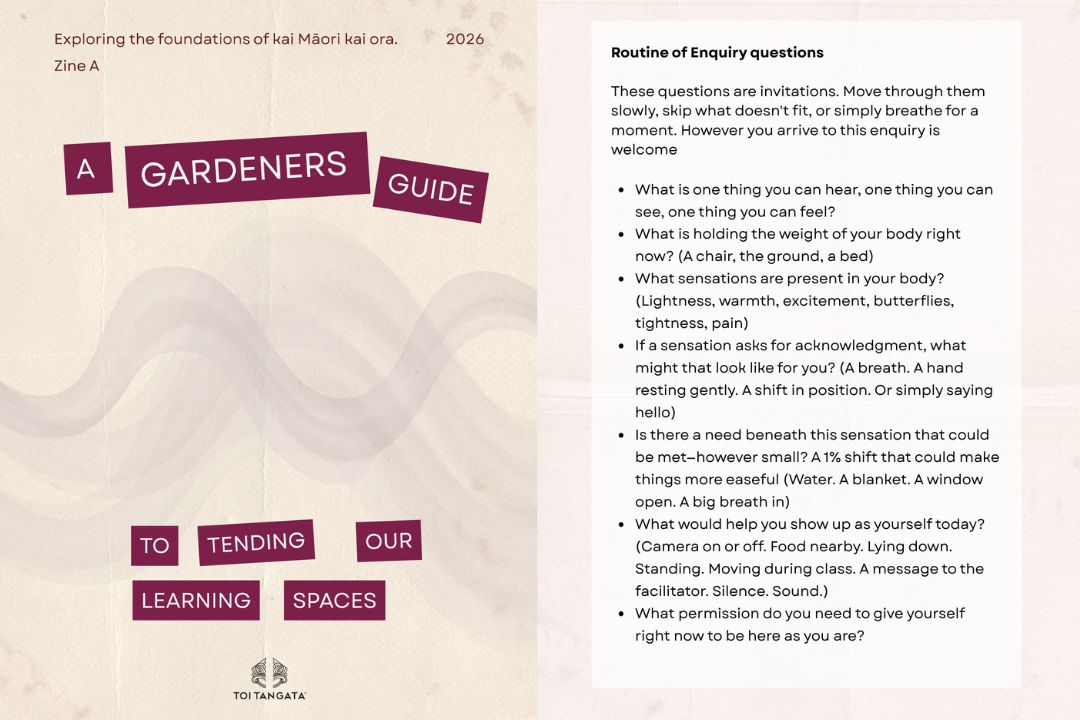
At the end of 2025 we engaged in a course re-design alongside Tātou〜Tātou Social Innovation Studio, recentering our learning objectives around whanaungatanga-centred learning. We created two zines to accompany our cohort through the nine weeks:
The first zine contains useful templates and resources to help us navigate the emotional fields of life and learning. These templates have emerged from various mutual aid, disability, and social justice spaces that understand the importance of building community capacity. These groups include:
The second zine contains a set of nine insights articulated as summary statements that we imagined could be precise, memorable, and widely applicable. These insights were grounded in the knowledge shared in Intergenerational Intimacies: A Whakapapa Conceptualisation of Kai by Hana Burgess and Haylee Koroi.
Guided by these insights and the learnings from previous weeks, each class has engaged with different source materials as a way to situate our learning.
In large part, this kaupapa has been about reminding us, as per our stories of creation, that kai is whanaunga. But what does that actually mean?
It means enjoying kai.
It means understanding kai as something that has its own mana, tapu, and mauri.
It means honouring kai despite the processes it might have endured.
It means acknowledging the many layers of whakapapa that make kai possible.
It means many things that we are yet to remember.
Here too, we must untangle ourselves from the reductive logics of western nutrition - logics that reduce kai to its nutrient function; that sort it into binaries of “good” and “bad.”
To return to our own mātauranga kai is to return to the expansive spaces in which we find mātauranga kai - from its emergence in the deeply localised, to its stretching out across oceans; from its embodied wisdom, to its celestial tohu. It is also about letting go of — and decentering — those knowledges we have been told are the only ones that matter: a universal western nutrition, built off the white-washing of Indigenous foods from around the world.
As food prices soar, nutrition is increasingly becoming a knowledge for those who can afford, in the first place, to choose. Meanwhile, the wider relations that make our kai possible are lost in the haze of optimising for maximum yields and idealised diets. Our wider relations — soil, water, ngahere — whose mauri continues to wane under colonialism, remain unnamed and unnoticed.
This system will not save us.
Will not save our mokopuna.
It will not make us well.
We have to do that ourselves.
Through this process of facilitation and learning alongside our tauira, the central work of KMKO has become increasingly evident. We won’t be teaching people about Kai Māori per se; the process of harvesting, the tohu of the taiao. That is the role of the whenua, of the awa, of kōrero tuku iho, of whānau and hapū.
Our work is to guide people in the intellectual and emotional work of believing that these knowledges really do matter — that they count, that they can offer us a future in which we are well. Enough so that the survival of our kai, our whanaunga — and all that comes with it — might actually move us.

